Latest Beijing Subway (Metro) Map + How to Use the Network like a Local
On this page, I’ll share the latest maps with a zoomable version and downloadable PDF, plus a full guide to using the network with ease. The Beijing Subway is modern, efficient, cheap, and easy to use. In most cases, it’s the fastest way to get around the city. Via the subway, you can visit almost all of the city’s central attractions with ease.
2026/27 Beijing Subway English/CN Map
Complete zoomable route map. Download: 2026 Beijing Subway PDF or an Image Version
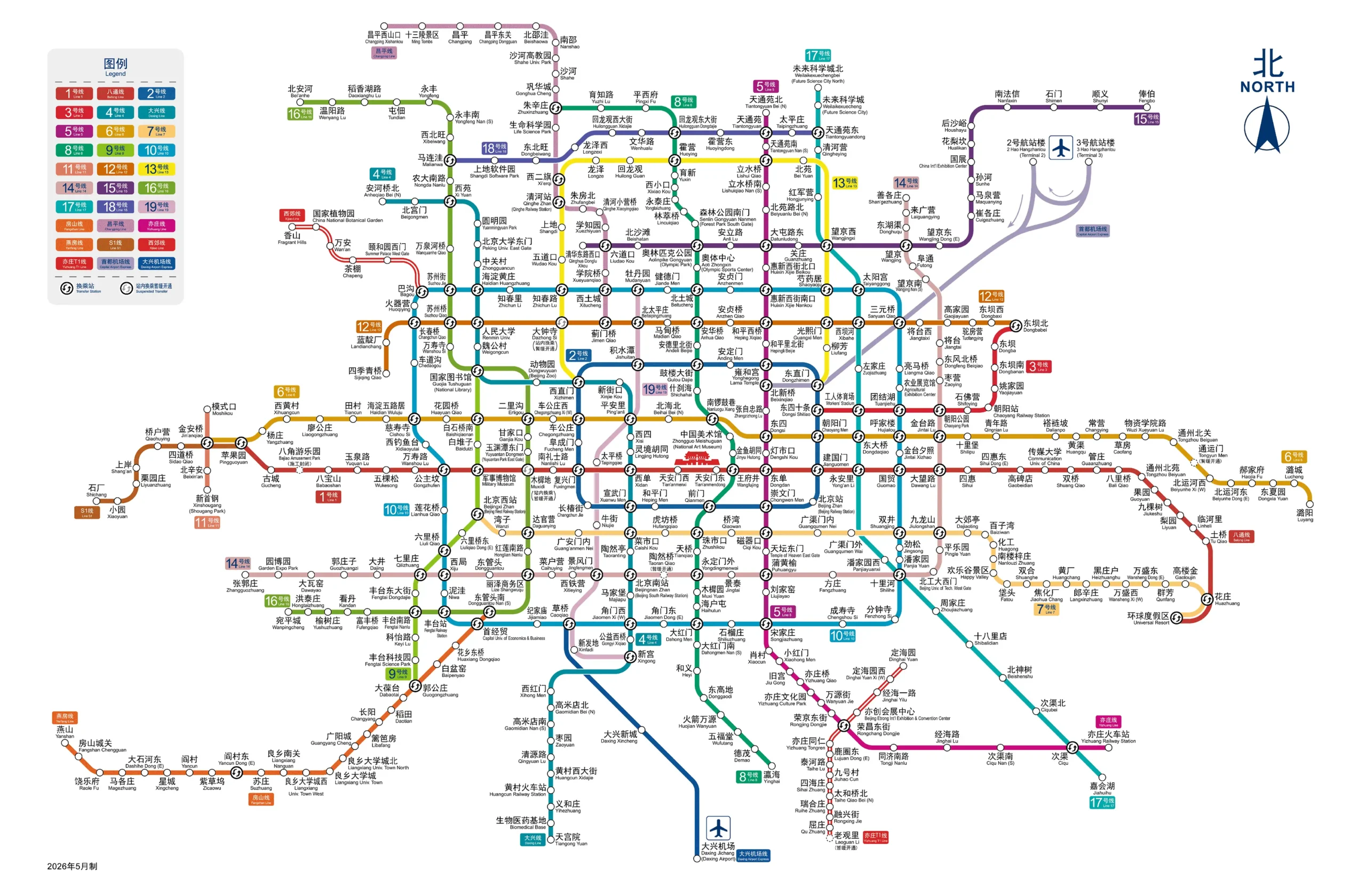
Lines serving the urban core
For visiting the city’s key attractions, visitors will find Line 1 and Line 2 the most useful. Line 10 (the big outer ring) is also very useful, especially if you are staying in Chaoyang.
Line 1 – a straight east-west line underneath Chang’an Avenue, which bisects the city through Tiananmen Square. Line 1 connects major commercial centres, Xidan, Wangfujing, Dongdan and the Beijing CBD. If you do nothing else, you’ll use this line.
Line 2 – the inner rectangular loop line traces the Ming-era inner city wall that once surrounded the inner city, and stops at 11 of the wall’s former gates as well as the Beijing Railway Station. Great for navigating the historic core.
Line 4 – a mainly north-south line running west of city centre with stops at the Summer Palace, Old Summer Palace, Peking and Renmin Universities, Zhongguancun Technology Park, National Library, Beijing Zoo, Xidan and Beijing South Railway Station. Think of it as the day trip line.
Line 5 – a straight north-south line just east of the city centre. It passes the Temple of Earth, Lama Temple, and the Temple of Heaven.
Line 6 – a nearly straight east-west line running parallel and to the north of Line 1. It passes through the city centre north of Beihai Park.
Line 7 – an east-west line running parallel and to the south of Line 1 and Batong Line, from Beijing West Railway Station to Jiaohuachang.
Line 8 – a north-south line following the city’s central axis from Changping District through Huilongguan and the Olympic Green to Shichahai and Nanluoguxiang inside the Second Ring Road.
Line 9 – a north-south line running west of Line 4 from the National Library through the Military Museum and Beijing West Railway Station to Guogongzhuang, southwest of city centre.
Line 10 – the outer loop line runs underneath or just beyond the Third Ring Road. Apart from the Line 2 loop, every line through the urban core intersects with Line 10. In the north, Line 10 traces Beijing’s Yuan-era city wall.
Line 14 – operates in two sections: an east-west line from Zhangguozhang to Xiju on Line 10, in the southwestern suburbs and an inverted L-shaped line from the Beijing South Railway Station east to Beijing University of Technology in the southeast before turning due north through the Beijing CBD, Chaoyang Park, Jiuxianqiao, and Wangjing to Shan’gezhuang in Chaoyang District.
Lines to outlying suburbs
The following lines run from the edge of the urban core to outer suburbs beyond the Fifth Ring Road.
Line 13 – arcs across suburbs north of the city and channels commuters to Xizhimen and Dongzhimen, at the northwest and northeast corners of Line 2.
Line 15 – starts from the east of Tsinghua University, passes the Olympic Green and Wangjing, and runs northeast to suburban Shunyi District.
Line 16 – runs parallel and to the west of Line 4. The northern section opened in 2016.
Batong Line – extends Line 1 eastward from Sihui to suburban Tongzhou District.
Changping Line – branches off Line 13 at Xi’erqi and runs north through suburban Changping District. The line passes the Life Sciences Park, Shahe University Park, and the Thirteen Ming Tombs.
Daxing Line – extends Line 4 south to suburban Daxing District.
Fangshan Line – extends Line 9 south from Guogongzhuang to Fangshan District in the southwestern suburbs.
Yizhuang Line – extends from Line 5’s southern terminus to the Yizhuang Economic & Technological Development Zone in the southeastern suburbs.
Xijiao Line – extends Line 10 – it’s a modern above-ground tram which is perfect for sightseeing as it passes the Summer Palace, the Beijing Botanical Garden, and terminates at Fragrant Hills Park.
Yanfang Line – extends the Fangshan Line – Terminating in Yangshan and servicing 9 stations over 16.6 km, it is the country’s first driverless subway.
Line S1 – extends Line 1 from Pingguoyuan station – Interestingly it’s a maglev line, but not a super-fast line like Shanghai, this one tops out at 100kph. The line connects a lot of historic attractions in the area inc. Lingguang Temple, Fahai Temple, Jieshi Village, and Housangyu Village.
Airport lines
Airport Express – connects the Beijing Capital International Airport, 27 km (17 mi) northeast of the city, with Line 10 at Sanyuanqiao and Lines 2 and 13 at Dongzhimen.
Daxing Airport Express – connects to the new Beijing-Daxing International Airport from Caoqiao Station where you can transfer to Line 10, Line 11 or Line 19. It is a fast rail (160 km/h) and uses driverless automated technology.
Apps and Maps for Navigating the Beijing Subway
I don’t recommend using Google Maps as the maps are quite outdated and don’t show the latest subway lines and stations.
App suggestion
- OsmAnd maps – Offline street maps with navigation
- Baidu maps – It’s in Chinese only, but you can point and click to get directions
Buying Tickets
Fare guide: 3RMB for the first 6km, 4RMB for 6 to 12km, 5RMB for 12 to 22km, 6RMB for 22 to 32km, and 1RMB for every additional 20km after that. Fares are capped at 10RMB with the exception of the Capital Airport Express, which costs 25RMB for a single trip, and the Daxing Airport Express ranges from 10 to 50RMB. Children under 1.3 meters have a free pass.
You can simply purchase tickets via touch-screen ticket machines (Chinese and English) at the station, with ticket vending machines accept 1RMB coins, plus 5RMB and 10RMB banknotes.
Beijing Subway also supports contactless payments from JCB and American Express cards, along with UnionPay, Mastercard, and Visa meaning you can simply tap and pay, ensuring that your card has the contactless symbol (the little wifi-like wave icon).
Beijing Pass – (recommended)
The Beijing Pass runs on the same infrastructure as the Yikatong mentioned below, but is specifically designed for foreign passport holders and no Chinese phone number or bank account is required. It can be used on the subway, buses, trams, suburban railway, Capital Airport Express, Daxing Airport Express, and Beijing taxis. It can be purchased at Beijing Capital International Airport, Daxing International Airport, and Beijing’s rail transit stations. You will need to show your passport when purchasing.
Why do I recommend the Beijing Card over using tap-to-pay with a credit card? It doesn’t suck so much when you lose your subway card 🙂
(Yikatong – 北京市政交通一卡通)
Yikatong, or the Transport Smart Card, enables you to simply swipe at the turnstile to enter and exit the metro. It’s very convenient. Saving the need to have small change and line up to buy tickets.
The card can be purchased for 20RMB (refundable), and you can top it up as you need. For a few days, seeing the sights, adding 50RMB is a safe bet. At the end of your time, you can return the card and get the refund and any remaining balance returned.
The cards are available at the Customer Service Centre of every metro station. It can also be used on buses, some taxis, the Airport Express Line, and more.
Essential Tips for Navigating with Ease
-

- Follow the signs
-

- Older Ticket Machines
-

- Tap on/Tap Off Entry gates
-

- Staff can be very helpful (and speak English)
-

- Quiet day, off -peak
-

- Keep your eyes on this
-

- Quiet day off -peak
-

- Normal peak time
Hours and crowds
- System runs roughly 5am–11pm (varies by line and station)
- Rush hour (7:30–9am, 5:30–7:30pm) on Lines 1, 10, and 4 is genuinely brutal. I urge you to avoid it, especially if you are carrying luggage.
- Weekends are much calmer than weekdays.
Navigation
- All signage is bilingual (Chinese + pinyin/English), so it’s very tourist-friendly.
- Announcements are made in both Mandarin and English.
- Download an offline map as connectivity inside underground stations can be patchy.
- Inside the railcar, usually located above the door, live screens will show the current location and the next stop.
Security & Luggage
- Every station has airport-style bag scanners. Budget an extra 2–3 minutes at busy stations.
- Large bags (backpacks, suitcases) go through the belt scanner, and nothing gets hand-searched in practice.
- No luggage item should be more than 30 kg in weight, more than 1.8 meters in length, or more than 0.5 meters in width/height.
Beijing Subway Facts
- The Beijing Subway system has 25 lines and over 350 stations! It’s the second-longest subway system in the world after the Shanghai Metro.
- Chinese Name: 北京地铁 Beijing Subway
- Official website: bjsubway.com/en/
Major Beijing Attractions by Subway
- The Olympic Forest Park – Take Line 8 to South Gate of Forest Park station.
- Beijing Happy Valley – Take Line 7 to Happy Valley Scenic Area station.
- The Palace Museum – Take Line 1 to Tian’anmen East station.
- Bird’s Nest – Take Line 8 to Olympic Sports Center station.
- Shichahai – Take Line 2 to Jishuitan station.
- Temple of Heaven Park – Line 5 to Tiantandongmen station.
- Summer Palace – Daxing Line to Xiyuan station.
- Nanluoguxiang – Line 6 to Nanluoguxiang station.
- Capital Museum – Line 1 to Muxidi station.
- Beijing Car Museum – Line 9 to Keyilu station.
- Confucian Temple and Imperial Museum – Line 5 to Yonghe Temple station.
- Shijia Hutong Museum – Line 5 to Dengshikou station.
- Geological Museum of China – Line 4 to Xisi station.
- National Museum of China – Line 1 to Tian’anmen East station.
- Chongwenmen CBD – Line 2/5 to Chongwenmen station.
- Dashilar pedestrian street – Line 2 to Qianmen station.
- Solana – Line 14 to Zaoying station.
- Wangfujing pedestrian street – Line 1 to Wangfujing station.
- Xidan CBD – Line 1/4 to Xidan station.
- Silk Street – Line 1 to Yong’anli station.
Popular Subway Stations
- Beigongmen Station
- Beihai North Station
- Beijing Station
- Beijing Zoo Station
- Chaoyangmen Station
- Chongwenmen station
- Dabaotai Station
- Dawang Road Station
- Dengshikou station
- Dongdaqiao Station
- Dongsishitiao Station
- Dongzhimen Station
- East Gate of Peking University Station
- Fuxingmen station
- Gongzhufen Station
- Gucheng Station
- Guomao Station
- Haidian Huangzhuang Station
- Jinsong Station
- Jishuitan station
- Liangmaqiao Station
- Life Science Park Station
- Liudaokou Station
- Liuliqiao East Station
- Majiapu Station
- Military Museum Station
- Nanlishi Road Station
- Nanlouzizhuang Station
- National Library Station
- Olympic Park Station
- Olympic Sports Center station
- Panjiayuan Station
- Pinganli Station
- Qianmen station
- Qingnian Road Station
- Renmin University Station
- Shichahai Station
- Shuangjing Station
- Taoranting Station
- Tiananmen East Station
- Tiantan East Gate Station
- Tiantandongmen station
- Tian’anmen East station
- Tuanjiehu Station
- Wangfujing station
- Wangjing South Station
- Xidan station
- Xizhimen Station
- Xuanwumen Station
- Yonghe Temple station
- Yong’anli station
- Yuanmingyuan Station.
- Zhiwuyuan Station
- Zhongguancun Station
This page was first published on Feb 25, 2012 and updated May 2026.